
Freqtrade Review
Freqtrade is a free, open-source cryptocurrency algorithmic trading bot written in Python, now on version 2026.3, offering strategy development, backtesting, optimization, live trading across a wide range of exchanges including Hyperliquid, and an AI-powered FreqAI module — with monthly releases keeping it one of the most actively maintained bots in the space.
TL;DR
This review covers Freqtrade, a free, open-source crypto trading bot built on Python. Now on version 2026.3 with monthly releases, it features strategy development, advanced backtesting with Hyperopt, an AI/ML module (FreqAI), and support for a wide range of exchanges including Hyperliquid. The learning curve is steep — Python familiarity is essential — but the community and tooling are first-class.
When I first stumbled upon Freqtrade in 2021, I was drowning in manual crypto trades and losing sleep (and money) trying to catch market movements. If you've ever tried day trading crypto, you know exactly what I'm talking about. Now, years later, the bot has matured significantly — and keeping this review current has become a task in itself, given how actively the project moves.
As of March 2026, Freqtrade is on version 2026.3, released just days ago. The project switched to a year-based versioning scheme (e.g., 2026.1, 2026.2, 2026.3) with monthly stable releases — a sign of real ongoing commitment from its maintainers.

What Exactly Is Freqtrade?#
Freqtrade is a free, open-source cryptocurrency trading bot written in Python that automates trading strategies across multiple exchanges. Unlike commercial alternatives that charge monthly subscriptions, Freqtrade won't cost you a penny beyond your trading capital.
The bot runs on Windows, macOS, and Linux, giving you flexibility in your setup environment. One thing I appreciate about Freqtrade is that it never takes custody of your funds — it simply connects to exchanges via API keys to execute trades based on your parameters.
As one experienced trader noted in a review, Freqtrade's framework is highly customizable, allowing complete control through Python scripts, though this comes with a learning curve.
Getting Started: Setup and Requirements#
Setting up Freqtrade requires some technical know-how. The current requirements are:
- Python 3.11 or newer (the old 3.7 minimum is long gone)
- Docker (recommended for easier setup)
- TA-Lib for technical indicators
- 2GB RAM minimum (more if running complex strategies or FreqAI)
The easiest implementation uses Docker, which simplifies deployment considerably. I initially tried setting up directly on my system and wasted hours troubleshooting dependencies. Trust me, just use the pre-built Docker images.
Installation documentation is comprehensive, though it assumes some familiarity with command-line interfaces. This isn't a point-and-click solution — Freqtrade primarily relies on command-line operation, with the optional FreqUI web interface providing visualization tools.
Note for macOS M1/M2/M3 (ARM64) users: The official docs currently recommend using Docker for ARM64 systems, as native installation is not officially supported.
Strategy Development: The Heart of Freqtrade#
Here's where Freqtrade really shines (or becomes a nightmare, depending on your coding comfort). You develop trading strategies using Python, pandas, and technical indicators from TA-Lib.
A basic strategy might look something like:
- Buy when RSI drops below 30
- Sell when price increases by 1.5%
- Set stop-loss at 2% below entry
But you can get far more sophisticated, incorporating:
- Multiple technical indicators
- Multi-timeframe analysis (from 5-minute to daily candles)
- Dynamic position sizing based on volatility
- Machine learning via the FreqAI module
The community maintains a strategy repository with templates you can customize, saving you from starting from scratch.
Backtesting: Test Before You Invest#
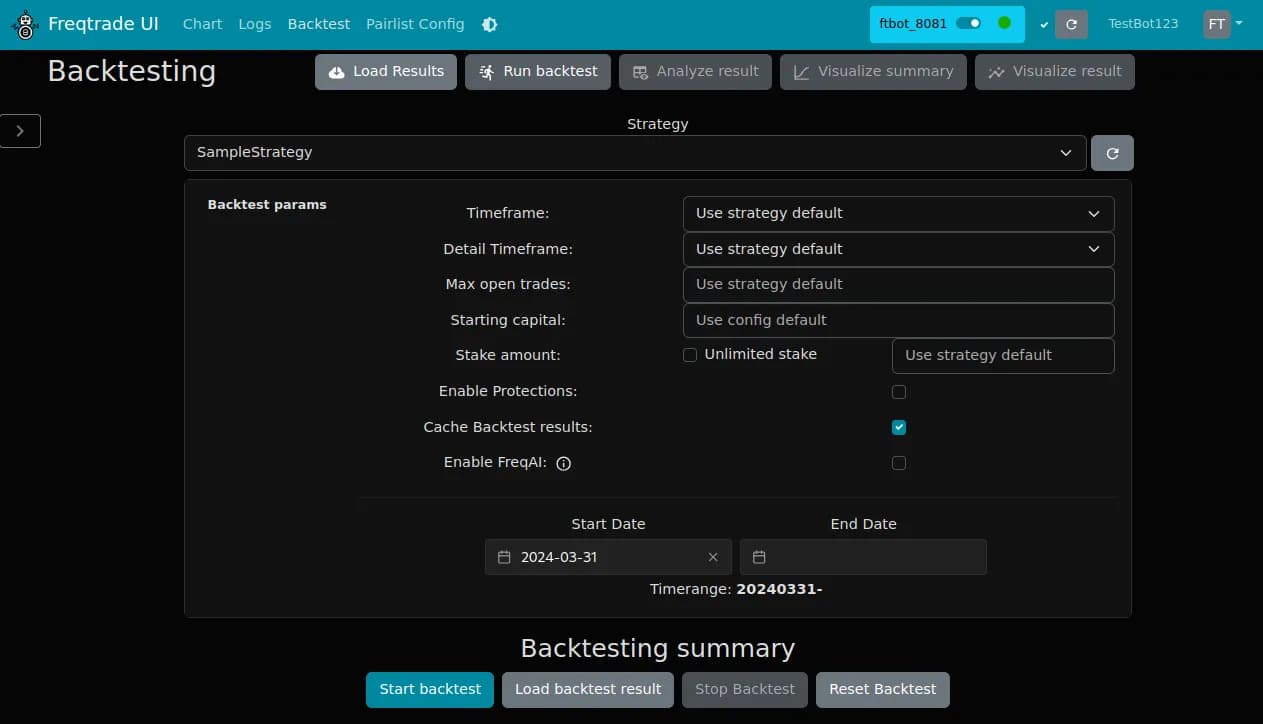
One developer who tested with a $20,000 dry run wallet emphasized the importance of thorough testing before committing real funds. Freqtrade's backtesting capabilities are honestly a godsend.
The backtesting engine lets you run your strategy against historical market data, generating detailed reports including:
- Total profit/loss
- Win rate and average trade duration
- Drawdown statistics
- Trade count and frequency
The Hyperopt utility takes this further by automating parameter optimization. It'll run thousands of backtests with different parameters to find the optimal configuration for your strategy. Recent releases have improved ROI exit rate accuracy in backtesting and fixed pairlock expiry behavior, making backtesting results more reliable than ever.
The 2026.2 release also added a new MaxDrawdown Protection mode using account drawdown — opt-in for now, but the old version is considered deprecated going forward.
FreqAI: Machine Learning for Strategies#
One of the most powerful additions to Freqtrade in recent years is FreqAI — a machine learning module that lets you train models on historical data to generate trading signals. As of 2026.3, FreqAI received early stopping support for PyTorch model training (early_stopping_patience option), making model training more efficient.
Previously, Catboost was a supported ML framework, but it was dropped in the 2025.12 release. The recommended frameworks now are LightGBM and XGBoost. If you relied on Catboost, there's a deprecation notice in the official docs explaining how to migrate.
Risk Management Features#
I learned the hard way that even the best strategy needs solid risk controls. Freqtrade offers several risk management tools:
- Stop-loss: Set fixed or dynamic stop-losses to limit downside. Bitget now also supports
stoploss_price_type(mark or last price) as of 2026.3. - Take-profit: Configure ROI (Return on Investment) tables for progressive profit-taking
- Trailing stops: Lock in profits as they accumulate
- Position sizing: The Edge module calculates optimal position sizes based on historical performance
- MaxDrawdown Protection: New account-drawdown mode for more precise drawdown-based circuit breakers
A common best practice among Freqtrade users is to use sub-accounts on exchanges, limiting how much capital the bot can access. This prevents catastrophic losses if something goes wrong.
Exchange Integration and Monitoring#
Freqtrade's exchange support has expanded significantly. The official supported exchanges now include:
Spot:
- Binance, Bybit, Bitget, Bitmart, BingX
- Gate.io, HTX, OKX / MyOKX
- Hyperliquid (decentralized exchange — a notable addition)
- Kraken
- Community-confirmed: Bitvavo, KuCoin
Futures:
- Binance, Bybit, Bitget, Gate.io, OKX
- Hyperliquid
- Kraken Futures (newly added in 2026.3)
Note: Bittrex, which was listed in older reviews, shut down in 2023 and is no longer supported.
The REST API and Telegram integration provide remote monitoring capabilities. I've set up Telegram alerts that notify me when trades execute, when my strategy hits profit targets, or if something requires my attention. Recent releases improved Telegram balance output formatting and added liquidation price to status messages.
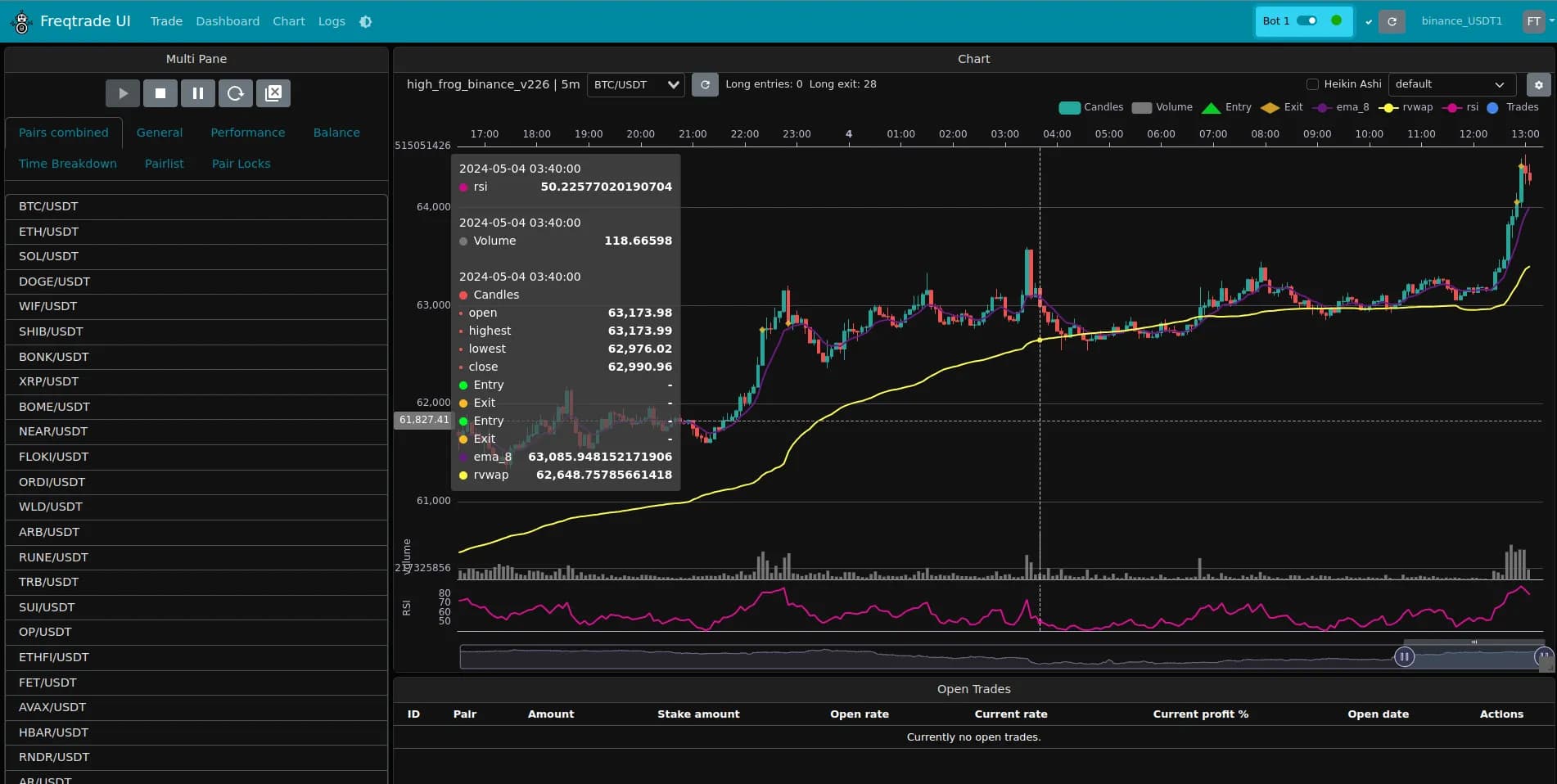
The optional FreqUI web dashboard has seen substantial improvements. As of early 2026, it shows:
- Live metrics: CAGR, Calmar, Sortino, and Sharpe ratios
- Chart annotations (including point-style annotations added in 2026.1)
- Multiple pairs on one screen
- Strategy parameters for running strategies
- Improved backtesting visualization in webserver mode
Community Support: You're Not Alone#
When I hit roadblocks (which happened often in the beginning), the active community proved invaluable. Freqtrade maintains a Discord server where users share strategies, troubleshoot issues, and discuss market conditions. As of early 2026, community members are actively testing 17+ strategies in real market conditions, with some reporting impressive results (e.g., a Simple-RSI strategy achieving 131% profit).
The regular updates via GitHub mean bugs get fixed quickly, and new features are constantly being added. Monthly stable releases (now year-versioned) ensure you're not constantly chasing the latest version. The 2026.2 release also included important API security improvements, including path traversal fixes and JWT key hardening.
Limitations and Challenges#
Let's be real — Freqtrade isn't for everyone. The steep learning curve and requirement for technical expertise create barriers for beginners. If you're not comfortable with Python 3.11+ or command-line interfaces, you'll struggle.
Strategy development takes time and patience. Even experienced traders emphasize the challenge of finding algorithms that match your risk appetite and market conditions.
The bot also requires ongoing maintenance. Exchanges update their APIs, market conditions change, and strategies that worked yesterday might fail tomorrow. If you rely on FreqAI with Catboost, you'll need to migrate to LightGBM or XGBoost.
Final Thoughts: Is Freqtrade Worth It?#
After years of using Freqtrade, I've found it to be an incredibly powerful tool — but one that requires significant investment in learning and development. In 2026 it remains one of the most actively maintained open-source trading bots available, with monthly releases and a growing feature set.
If you're looking for a plug-and-play solution that guarantees profits, look elsewhere (and be skeptical of anyone promising such things in crypto). But if you're willing to learn Python, experiment, and continuously improve your strategies, Freqtrade offers a robust framework without the subscription fees of commercial alternatives.
Just remember what one trader wisely pointed out — automated trading can help prevent emotional mistakes like FOMO and revenge trading, but it's not a substitute for understanding the market. The bot is only as good as the strategy you give it.
About Ares Sanchez
• Captain of the ship at gainium.ioI am the founder of Ganium.io, a cryptocurrency bot platform. I'm also an avid meditator and fitness and health enthusiast. In my spare time, I like to code small utilities that do work for me, so I never have to work again. Despite being what some would call a "serial procrastinator", I have some unique talents that have served me well in life. For example, I can always put the USB-C connector in the right way on the first try, I'm an expert at picking things up with my toes, and I can move only one eye at will.