
Passivbot Review
Passivbot is an open-source automated cryptocurrency trading system now on v7.8.4, specializing in grid and trailing-order strategies for perpetual futures markets. Recent versions added a TWEL Enforcer for risk management, a Forager feature for dynamic market selection, Hyperliquid and GateIO support, and a Rust-powered orchestrator for faster backtesting and optimization.
TL;DR
Passivbot is an open-source, high-frequency grid and trailing-order trading bot designed for perpetual futures markets, now on v7.8.4. Key 2025-2026 additions include a Rust-powered orchestrator, TWEL Enforcer for exposure risk management, a Forager for dynamic market selection, and support for Hyperliquid and GateIO. Python 3.12 is now required. Best suited for advanced traders comfortable with technical setups and active risk monitoring.
For years, I've watched crypto traders debate automated trading systems, and Passivbot has consistently sparked interesting conversations. This open-source trading system has gained traction among those looking to automate their crypto trading, particularly in the volatile world of perpetual futures markets. With the project now at v7.8.4, a lot has changed since the early versions — and not just superficially.
What Exactly is Passivbot?#
Passivbot is an open-source cryptocurrency trading bot written in Python and Rust. It's designed specifically for hands-off trading, letting you set parameters and then letting the bot handle execution without constant babysitting. I remember setting up my first trading bot years ago and checking it every five minutes – not exactly the "passive" experience promised!
According to the GitHub repository, Passivbot operates on perpetual futures derivatives markets, automatically creating and cancelling limit buy and sell orders. Crucially, it doesn't try to predict future price movements or follow trends — rather, it acts as a contrarian market maker, providing resistance to price changes in both directions.
The bot specializes in grid trading strategies with Martingale elements, essentially creating a mesh of buy and sell orders at different price levels to profit from market volatility. This approach helps capitalize on price fluctuations rather than trying to predict market direction — which, let's be honest, is practically impossible to do consistently.
Important note for existing users: Passivbot now requires Python 3.12. Earlier versions are not supported in the v7.x series.
Supported Exchanges and Markets#
One thing I appreciate about Passivbot is its flexibility across platforms. As of v7.8.4, it supports the following exchanges through direct API integration:
- Bybit
- Binance
- Bitget
- OKX
- Gate.io
- KuCoin
- Hyperliquid (added in recent versions — a significant new addition given HL's growth)
This is a notable expansion from earlier versions. Particularly, Hyperliquid support has been progressively improved — v7.8.4 added bulk price fetching via a single allMids API call (instead of ~70 individual calls), and Hyperliquid now has a dedicated Reference Vault running Passivbot's default template config live.
The bot handles order management automatically, which is crucial when running multiple positions simultaneously.
How Passivbot Works: Trading Strategies#
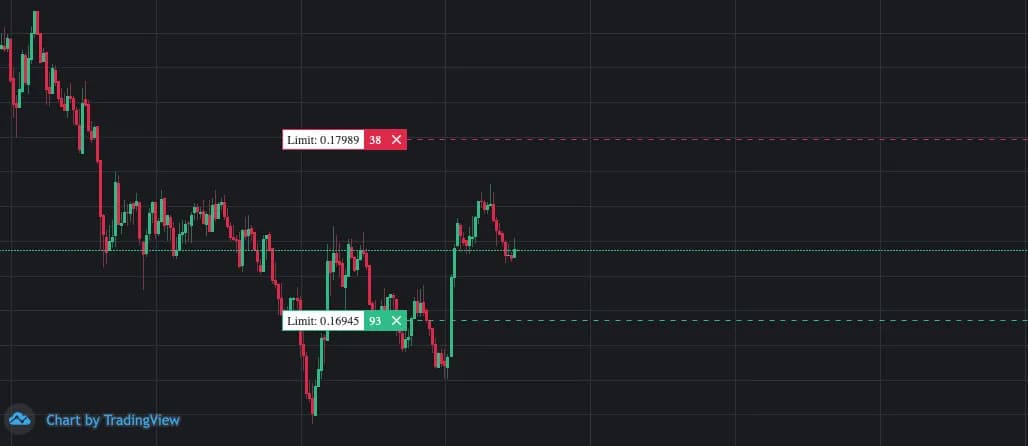
Passivbot uses grid trading at its core — a strategy that places orders at regular intervals above and below the current price. What makes it special is its implementation of position management with Martingale-inspired elements: the bot makes a small initial entry and doubles down on losing positions multiple times to bring the average entry price closer to current price action.
After each re-entry, the bot quickly updates its closing orders at a set take-profit markup. If there's even a minor market reversal, the position can be closed in profit.
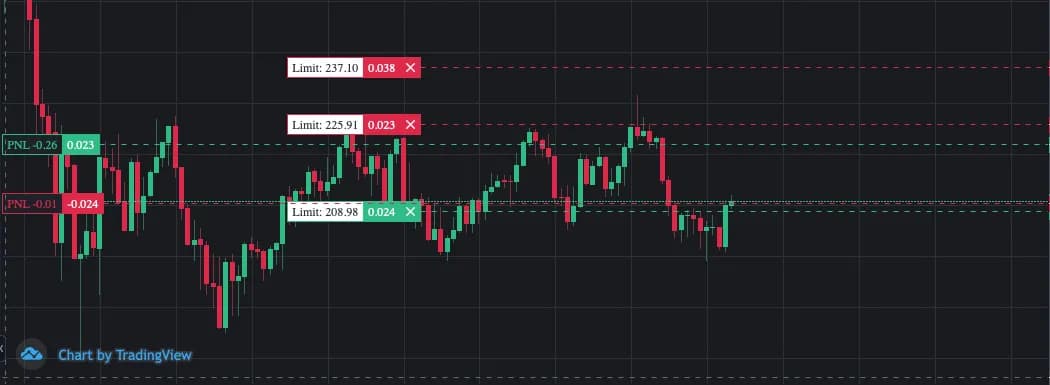
Recent versions added trailing entries and trailing closes as an alternative or complement to fixed grid orders. For trailing entries, the bot waits for price to move beyond a threshold and then retrace before placing a re-entry order. For trailing closes, it waits until price has moved favorably by a threshold and then retraced before closing. Grid and trailing orders can be combined for hybrid position management.
The Forager Feature
One of the most interesting additions in recent versions is Forager — a mode that dynamically selects the most volatile markets on which to open positions. Volatility is measured as the mean normalized relative range of recent 1-minute candles: mean((high - low) / close). This helps the bot automatically allocate positions to markets where grid strategies work best, rather than trading the same fixed pairs.
TWEL Enforcer (Risk Management)
The v7.5.0 release introduced the TWEL Enforcer — a Rust-powered mechanism that auto-reduces positions when total wallet exposure drifts beyond a set buffer. This is a major risk management improvement. You configure risk_we_excess_allowance_pct, risk_wel_enforcer_threshold, and the bot handles position sizing prioritization automatically.
The v7.8.4 release also added live.max_realized_loss_pct (default 0.05), which blocks close orders that would realize losses beyond a peak-balance-relative threshold.
Backtesting and Optimization: The Secret Sauce#
In my experience, what separates the winners from losers in algorithmic trading isn't just the strategy but the quality of backtesting. Passivbot shines here with comprehensive historical backtesting capabilities.
The Rust orchestrator — shared between live trading and backtesting — ensures consistency between backtest results and live behavior, a significant improvement over older versions. Recent enhancements include:
- Configurable candle aggregation (
backtest.candle_interval_minutes, default 1) for faster optimizer runs - High-exposure duration metrics:
high_exposure_hours_{mean,max}_{long,short} - Total wallet exposure charts (
total_wallet_exposure.png) output for each backtest - New PnL-based performance metrics:
adg_pnl,mdg_pnl, PnL-based Sharpe/Sortino ratios
The configuration optimizer tests thousands of parameter combinations using an evolutionary algorithm to find optimal settings. For those who don't want to start from scratch, there's a community configuration database with pre-optimized templates — though I'd still recommend testing these against recent market data before going live.
Setting Up Passivbot: Technical Requirements#
Fair warning — Passivbot isn't for absolute beginners. You'll need:
- Python 3.12 (strictly required — earlier versions will not work)
- Rust compiler (for the performance-critical orchestrator components)
- Your own exchange API keys
- Some technical understanding of cryptocurrency markets
The setup involves compiling Rust components, though Passivbot will attempt to do this automatically when installing with pip install -e .. Manual recompilation is straightforward:
cd passivbot-rust
maturin develop --release
There's no official mobile app or web interface — just command-line and Jupyter-based interfaces. For those seeking a more user-friendly experience, there's a community-developed GUI available through the third-party pbgui repository.
Real User Experiences: The Mixed Bag#
Real-world results with Passivbot have been mixed, which honestly reflects the nature of grid trading in general. One user reported a 6.3% annual return over 100 days, but noted that simply holding Bitcoin would have yielded 16% during the same period.
Another experienced trader tested grid trading bots for 1.5 years and achieved 30% returns with Bitcoin while breaking even with Ethereum. They found that bots outperformed lump-sum investing during bear markets but underperformed dollar-cost averaging.
A common theme emerges: grid trading bots like Passivbot perform better in sideways markets than trending ones. They can provide consistent small gains but often miss larger market moves — a tradeoff worth considering.
Risks and Limitations: Proceed with Caution#
Let's not sugarcoat it — automated trading involves significant risks, especially in leveraged futures markets. The project documentation clearly warns users with a prominent "Used at one's own risk" notice.
Some notable limitations include:
- No stop-loss orders — the system relies entirely on limit orders and the TWEL Enforcer for exposure management
- Requirement for manual intervention during extreme market conditions
- No official insurance or loss protection
- Performance varies significantly based on market conditions (sideways vs. trending)
- Requires ongoing monitoring even with automation — Passivbot is not fully "set and forget"
As someone who's tested various trading systems, I've learned that no bot is completely hands-off. Even with Passivbot's sophisticated approach and the TWEL Enforcer, it's wise to monitor positions during unusual market events.
The Business Model: Open Source with Options#
Passivbot is free open-source software available on GitHub, released into the public domain (Unlicense). The project is supported through:
- Optional donations (BuyMeACoffee, crypto addresses)
- Referral commissions from exchange sign-ups (Bybit, Binance, Bitget, OKX, Hyperliquid, KuCoin referral links are listed in the README)
The hybrid model seems to support ongoing development while keeping the core technology accessible to all.
Final Thoughts: Is Passivbot Right for You?#
If you're technically inclined, comfortable with Python 3.12 and Rust compilation, and understand cryptocurrency futures markets, Passivbot v7.8.4 offers a sophisticated and actively maintained trading solution worth exploring. The Rust-powered orchestrator, TWEL Enforcer, Forager, and Hyperliquid support are substantial upgrades that make this a meaningfully different tool than it was even a year ago.
However, if you're looking for guaranteed profits or a completely hands-off experience, you might want to reconsider. As with all trading systems, there's no free lunch — Passivbot requires time, understanding, and careful risk management to use effectively.
Remember what an experienced trader once said: "Bots are tools, not magic money machines." That perspective has saved me from many unrealistic expectations over the years.
About Ares Sanchez
• Captain of the ship at gainium.ioI am the founder of Ganium.io, a cryptocurrency bot platform. I'm also an avid meditator and fitness and health enthusiast. In my spare time, I like to code small utilities that do work for me, so I never have to work again. Despite being what some would call a "serial procrastinator", I have some unique talents that have served me well in life. For example, I can always put the USB-C connector in the right way on the first try, I'm an expert at picking things up with my toes, and I can move only one eye at will.