
Gainium Logo

DCA Bot

A Gainium DCA bot automatically buys crypto in smaller, staggered orders instead of one lump sum, lowering your average entry price when the market dips. It runs on 9 connected exchanges and is free to run on the 250-credit plan or unlimited when self-hosted.
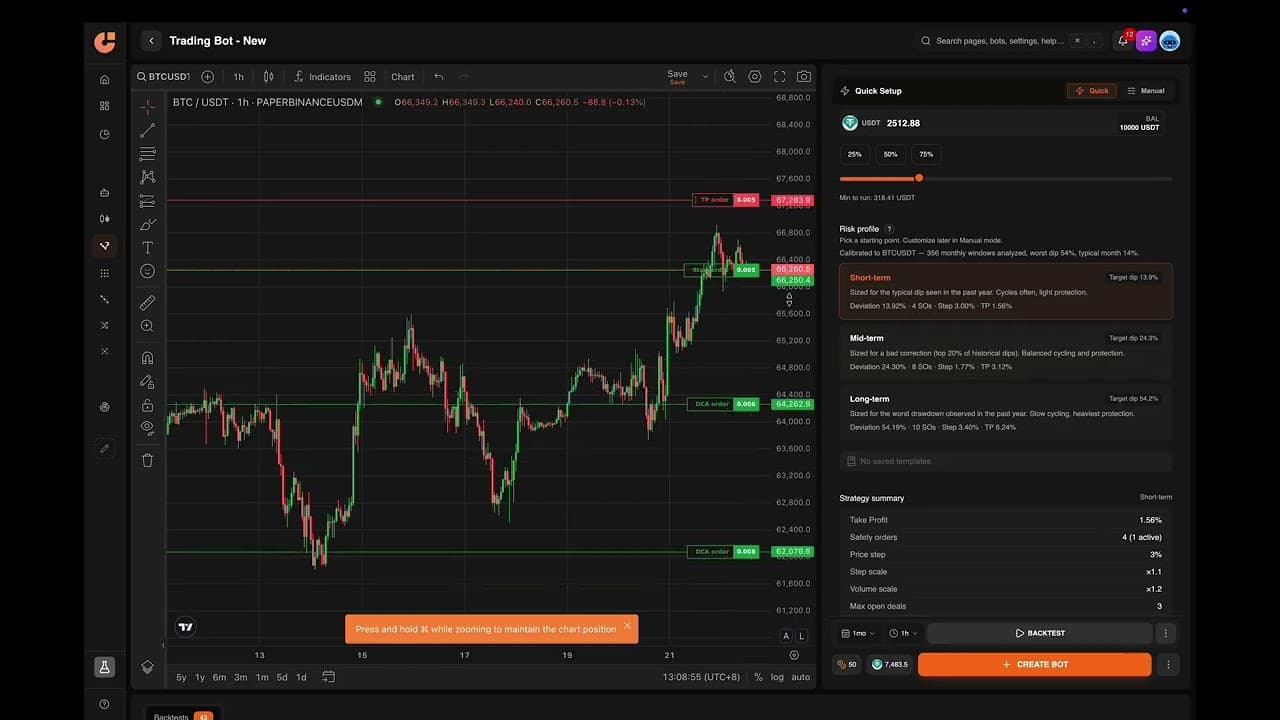
Feature Overview

Features

Lower Risk of Volatility

Splitting your investment and buying at better prices lead to lower acquisition cost and less volatility in your portfolio.

Beginner Friendly

DCA bots are easy and intuitive to set up.

Backtest and Paper Trade

Test your DCA bots with zero risk thanks to our cutting-edge backtester and paper trading tools.

DCA Strategies

Price-DCA

Invest money at specific intervals dictated by deal start conditions using volume and deviation Martingale strategies.

Time-DCA (HODL Bot)

Invest a fixed amount of money at specific time intervals, regardless of the price. Perfect for long-term accumulation.

Martingale DCA

Increase investment amounts after price decreases to lower average entry price and recover losses faster.

Adaptive DCA

Adjust investment frequency and amounts based on market conditions and technical indicators.

Multi-Pair DCA

Create DCA bots for multiple cryptocurrencies simultaneously to diversify your portfolio automatically.

Risk Management

Set investment limits, stop-loss orders, and position sizing to protect your capital while accumulating.

How a Gainium DCA bot works

Setting up your first bot takes minutes — no code required. Here is the full flow, start to finish.

  1. 1Connect an exchange to Gainium with read/trade API keys — Binance, Bybit, OKX, KuCoin, Coinbase, Bitget, Kraken, Binance US, or Hyperliquid.
  2. 2Pick a pair (or several pairs) and choose a base order size your allocated capital can support.
  3. 3Set your safety orders: how much the price must drop before the bot buys again, and how much larger each follow-up order should be.
  4. 4Define your exit — a take-profit target that closes the deal in profit once the averaged position recovers.
  5. 5Backtest and paper trade the configuration for free, then start the bot live and let it average in automatically.

New to the strategy? Read the backtesting guide or compare it with the grid bot and the hybrid combo bot.

Gainium vs 3Commas vs Cryptohopper for DCA

An honest, side-by-side look at how the leading no-code DCA platforms compare. Figures last verified April 2026 — see the full Gainium vs 3Commas and Gainium vs Cryptohopper breakdowns.

FeatureGainium3CommasCryptohopper
DCA botDedicated bot typeCore bot typeStrategy within trading bot
Supported exchanges91614
Free planFree-forever (250 credits) + free self-hostedFree trial onlyPioneer — manual trading only, no bots
BacktestingUnlimited & freePlan-limited (100–5,000/mo)Plan-limited (Explorer: 1/day)
Futures tradingAll plansPro tier and upLimited (spot-focused)
Self-hosted optionCommunity Edition (free, unlimited bots)NoNo
Combo bot (Grid + DCA hybrid)Yes (unique)NoNo
Trustpilot rating4.4 / 54.2 / 53.6 / 5
Where the competitor is strongerWider exchange coverage (16), native mobile app, Signal bots with TradingView Pine Script, and a dedicated asset-manager product.Strategy marketplace, arbitrage and copy-trading bots, native mobile app, and 130+ built-in indicators.

Bottom line: 3Commas and Cryptohopper offer broader exchange lists and mobile apps, while Gainium's edge for DCA is a genuinely free entry point (free-forever cloud plan plus unlimited self-hosting), unlimited backtesting, futures on every plan, and the unique Combo bot.

Frequently Asked Questions

Gainium allows you to create a DCA bot with multiple pairs, allowing them to buy multiple coins with only a few clicks. You can also decide to create multiple DCA bots for each pair.

Yes. Open the bot from your Bots dashboard and use the Stop or Pause control — the bot immediately stops opening new deals. Any deals already running keep their existing take-profit and safety-order logic until they close (or you can close them manually), and you can restart the bot at any time. Nothing is deleted when you pause, so your configuration and history are preserved.

Gainium DCA bots run on 9 connected exchanges: Binance, Binance US, Bybit, OKX, KuCoin, Coinbase, Bitget, Kraken, and Hyperliquid. You connect an exchange with read/trade API keys, and the same bot configuration works across whichever venue you choose.

Yes, you can start for free. The cloud plan includes 250 Bot Credits at no cost, and backtesting is always free and unlimited. If you self-host the open-source Community Edition via Docker, you can run unlimited bots on all supported exchanges for free, forever. Paid cloud tiers add more credits and capacity.

This depends on the exchange you connect. Your per-order size can be as small as the exchange's minimum order value — on Bybit, for example, deals can start from roughly $2. Keep in mind that DCA bots are designed to fill several safety orders as the price moves, so your bot needs enough allocated capital to cover all of those orders, not just the first one.

There are two cost layers. First, your exchange charges its standard trading fee on every order — Binance spot, for example, is around 0.1% per trade. Second, most bot platforms add their own subscription: 3Commas and Bitsgap charge a monthly or annual fee, and Pionex charges based on trading volume. Gainium's cloud platform has a free-forever plan (250 credits) and its self-hosted Community Edition is free with no bot limits, so on Gainium you can run DCA bots while paying only your exchange's trading fees.

Dollar Cost Averaging (DCA) is a trading strategy that involves splitting the investment into several parts rather than investing all at once. DCA can be applied to various assets, including stocks, bonds, and cryptocurrencies. In the context of cryptocurrency trading, DCA is often used as a long-term strategy.

One of the best ways to use DCA to build up your trading portfolio is to determine how much capital you are putting into your investment. This applies to any other market you decide to trade: commodities, forex, and stocks. Instead of investing a pre-determined amount in a single place, you will instead invest in incremental investments in several orders. It's a simple way to perform the transactions yourself or by using bots that perform the work for you. Dollar-cost averaging is designed for price volatility, so if the price drops, this represents a buying opportunity.

DCA means dollar cost averaging. This type of investment strategy consists mainly of dividing an investor's total investment into a variety of different purchases of a specific asset in a bid to minimize the risk of volatility associated with purchasing.

Price-DCA (Dollar-Cost Averaging) and Time-DCA (Time-Based Dollar-Cost Averaging) are two different strategies and in Gainium for DCA bot we refer to the Price-DCA bot. Price-DCA involves investing money at specific intervals dictated by the deal start conditions. This strategy most of the time uses a volume Martingale and a deviation Martingale. Time-DCA, on the other hand, involves investing a fixed amount of money at specific time intervals, regardless of the price. Gainium refers to this kind of Time-DCA bot as the HODL bot. The main difference lies in how the investment amount is allocated.

While Dollar Cost Averaging (DCA) is generally considered a strategy that can help reduce the impact of price volatility and potentially mitigate losses over the long term, it does not guarantee profits or eliminate the possibility of losing money. Market downturns, asset selection, timing, and market volatility can all impact your results. If the market experiences a prolonged and significant downturn, the value of your investments may still decrease, potentially resulting in temporary losses.

The choice between Dollar Cost Averaging (DCA) and Grid bot strategies depends on your personal preferences, risk tolerance, and investment goals. DCA is a long-term strategy, while Grid bot strategies are more short-term or intermediate-term strategies. DCA helps mitigate the impact of short-term volatility, while Grid bot strategies involve actively trading within a predefined range. DCA is generally considered a lower-risk strategy, whereas Grid trading bot strategies may involve higher risk due to active trading.

Managing risk with DCA bots involves several key factors: Set investment limits to control exposure, define DCA parameters including frequency and size of purchases, assess asset selection through thorough research, regularly monitor and review performance, implement additional risk mitigation techniques like stop-loss orders, keep realistic expectations as DCA is a long-term strategy, and stay informed about market trends and developments.

A Dollar Cost Averaging (DCA) bot does not guarantee profits or make money in itself. It is a strategy that aims to mitigate the impact of short-term price volatility and potentially generate returns over the long term. The profitability depends on long-term growth of assets, cost averaging by purchasing more units when prices are low, and reduced timing risk by spreading investments over time.

Determining the "best" Dollar Cost Averaging (DCA) bot strategy depends on your individual goals, risk tolerance, and market conditions. Popular strategies include: Fixed Interval DCA (regular fixed investments at predefined intervals), Percentage-Based DCA (investing a fixed percentage of portfolio), Price Threshold DCA (triggering investments at specific price levels), and Adaptive DCA (adjusting based on market conditions). Gainium has all the tools to help you fine-tune your strategy.

It varies with the assets you trade, overall market conditions, how you configure your safety orders and take-profit, and how long you stay invested. Because DCA lowers your average entry price during dips, it tends to work best in volatile or gradually recovering markets and worst in prolonged downtrends. No bot can guarantee a return — results depend entirely on your settings and the market, which is exactly why Gainium lets you backtest and paper trade any configuration for free before you commit real capital.

In the context of a DCA bot, a Martingale DCA strategy refers to a specific approach that involves increasing the investment total amount after each unsuccessful trade or price decrease. You start with an initial investment (e.g., $100), and if the trade results in a loss or the asset's price decreases, you double the investment on the next trade to try to recover the losses. The goal is to keep doubling the investment amount with the expectation that eventually, a winning trade will occur and the average entry price will recover the accumulated losses and generate a profit.

Your edge won't find itself

Test it, automate it, improve it — everything you need to trade with confidence is free to start, secure, and open source.

Get started in minutes — no credit card required

Secure

State-of-the-art encryption, optional IP whitelisting, and open-source code you can audit or self-host.

Fast & Reliable

Built for speed and reliability, even during high volatility periods.

Easy to Use

Sign up, connect your exchange, and start profiting in minutes.